How Do I Choose the Right Online Bible Course?

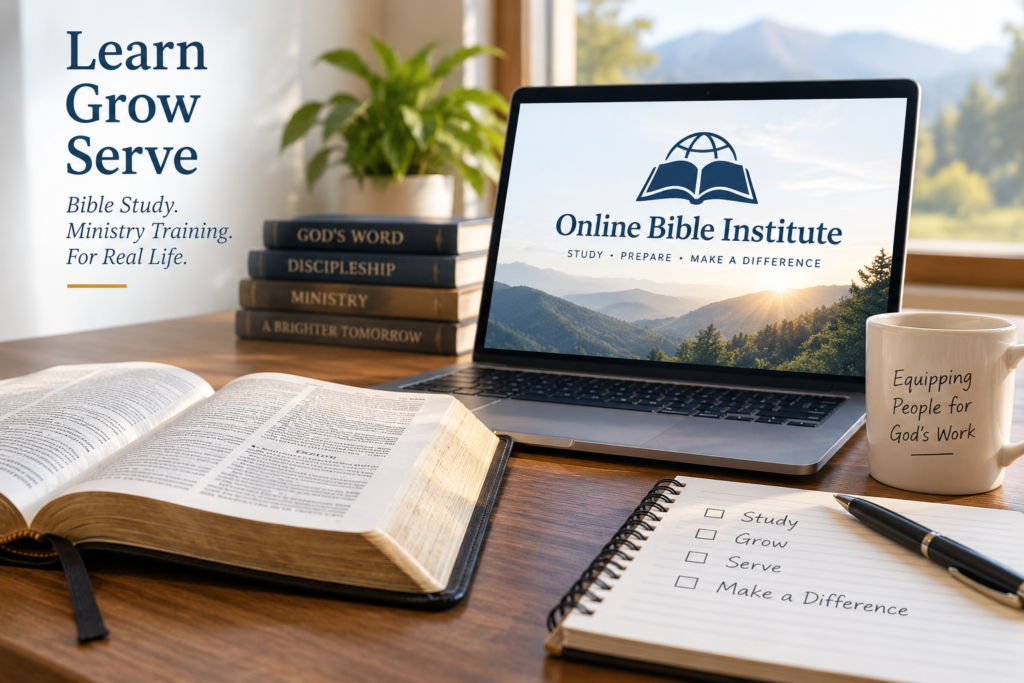
Choosing the right online Bible course begins with identifying what you want to learn, considering your current understanding of Scripture, and selecting a course that fits your goals and available study time. Beginners may benefit from introductory Bible courses, while experienced students may prefer theology, biblical interpretation, leadership, or specialized ministry training.
At Online Bible Institute, students can explore biblical and ministry education through flexible online learning opportunities.
Where Should I Begin if I Am New to Bible Study?
If you are beginning formal Bible study for the first time, start with the foundations.
Courses introducing the Old Testament, New Testament, and basic principles of biblical interpretation can help you understand how Scripture fits together.
Learning the overall story of the Bible provides a framework for understanding individual passages.
You do not need to begin with the most advanced course to make meaningful progress.
What if I Already Know the Bible Fairly Well?
Students with previous biblical knowledge may benefit from exploring subjects in greater depth.
These might include biblical theology, church history, Christian doctrine, ministry leadership, evangelism, or particular books of the Bible.
The best course is not necessarily the one that sounds most impressive.
It is the one that helps you grow in an area where additional understanding would be valuable.
Should I Choose Courses Based on My Ministry Interests?
That can be a helpful approach.
Someone serving in children’s ministry may want a stronger understanding of the biblical story and Christian formation.
A small-group leader may benefit from studying biblical interpretation and teaching methods.
A person interested in pastoral care might explore courses related to Christian ministry, theology, and relationships.
Connecting education with practical service can make learning especially meaningful.
What Is the Difference Between Taking Courses and Following a Program?
Individual courses allow students to explore subjects according to their interests.
Structured programs provide a more intentional sequence of study.
Both approaches have value.
If you are exploring biblical education for the first time, taking an individual course may help you understand what online learning involves.
If you want a broader educational foundation, review the Online Bible Institute programs to see whether a structured pathway would be appropriate.
How Important Is My Available Study Time?
Very important.
Students sometimes begin with ambitious expectations that become difficult to maintain alongside work, family, and church responsibilities.
A realistic study schedule is usually more sustainable.
Before choosing a course, consider how much time you can consistently devote to reading, watching lessons, taking notes, and completing required activities.
Read the course expectations carefully so that you understand what participation involves.
What Should I Look for in a Bible Course?
Look for a course with clear learning objectives, faithful engagement with Scripture, organized instruction, and expectations appropriate to your experience.
Consider the subject matter, the course provider, and how the course fits your educational goals.
It is also helpful to understand the theological perspective from which a course is taught.
Students can review the course providers represented within the Online Bible Institute learning environment.
Does Online Bible Education Need to Be Expensive?
No. Meaningful biblical education does not necessarily require traditional tuition expenses.
Online Bible Institute seeks to make biblical and ministry education accessible without traditional tuition charges.
However, accessibility does not eliminate the need for commitment.
Students are responsible for engaging the materials, completing required work, and approaching their studies seriously.
What if I Want to Prepare for Christian Ministry?
Students interested in ministry preparation may benefit from a more structured course of study.
The Certificate in Christian Ministry is one option to explore.
Ministry preparation should include biblical understanding, theological foundations, spiritual formation, and practical service.
Formal study can support these areas, but it should remain connected to Christian community and actual ministry experience.
Should I Study With a Particular Goal in Mind?
Having a goal can help you stay focused.
Perhaps you want to understand the Bible more clearly, strengthen your relationship with Jesus, prepare to teach, develop leadership skills, or explore a possible calling.
Your goal does not need to be complicated.
It can be as simple as wanting to become a more faithful student of Scripture.
As you learn, your interests and direction may become clearer.
How Can I Apply What I Am Learning?
Learning becomes more meaningful when it shapes everyday life.
Discuss what you are studying with other Christians. Reflect on how Scripture challenges your assumptions. Look for opportunities to serve.
Jesus emphasized the importance of hearing His words and putting them into practice (Matthew 7:24–25).
Biblical education should help us become people who increasingly live what we are learning.
What Is the Best First Step?
Begin by exploring the Online Bible Institute course library.
Identify one subject that would help you grow. Review the course information and expectations. Consider whether it fits your schedule and current level of understanding.
Then begin.
You do not need to plan your entire educational journey before taking your first course.
For additional resources in Bible study, spiritual growth, ministry training, and church health, visit Bible Institute Network.
The purpose of Christian education is not simply to complete courses or accumulate knowledge.
It is to know God more deeply, understand His Word more faithfully, and become better equipped to participate in His purposes.
Choose a course that helps you take the next step in that journey.